Wednesday, January 30, 2013

Welcome! We've Moved!

051


Quips, Travails, and Braised Oxtails has packed up, nose-to-tail, and moved to ChicagoNow.  I post every Wednesday and Sunday, so please bookmark the new page and come find out what we're cooking!


Cut-and-paste link is www.chicagonow.com/quips-travails-braised-oxtails

And if you're looking for a specific recipe, here is our Recipe Index

Thursday, December 13, 2012

Moving..BEEP..BEEP...BEEP

The time has come for a little change, my friends. Quips, Travails, and Braised Oxtails is packing up nose-to-tail and moving to ChicagoNow.

I hope you'll all enjoy the new format, and follow me here:


Quips, Travails and Braised Oxtails


Thank you all for supporting me - make sure you check out all the features and reset your RSS feeds and readers for the new location!

Wednesday, December 12, 2012

Policy Point Wednesday - School Lunch: Two Steps Forward, One Step Back?

This Friday, USDA Secretary Tom Vilsack sent a letter to Congress outlining new changes to the National School Lunch Program.  As you may have read, the new lunches have come under fire primarily for reductions in meats, meat alternates and grains.  Vilsack reports that while the original Healthy, Hunger-Free Kids Act was carefully developed to best meet the needs of the students it serves, the USDA has decided on some changes.

The blog Obama Foodorama linked a copy of Vilsack's letter, which states:
  • "This flexibility is being provided to allow more time for the development of products that fit within the new standards while granting schools additional weekly menu planning options to help ensure that children receive a wholesome, nutritious meal every day of the week."
In addition to complaints about hungry kids and kids who won't eat vegetables, the USDA has been made aware that school lunchrooms aren't able to find products that allow them to keep grains and proteins within both the minimum and maximum calorie requirements for the program.  Essentially, Vilsack has decided to waive the calorie cap on these products for the time being - how that will translate to students' plates remains to be seen.

Vilsack does note that the new guidelines still offer twice as many fruits and vegetables and more whole grains than prior school lunches.
     "As directed by Congress under the HHFKA, USDA relied on the recommendations of experts like the Institute of Medicine- a gold standard for scientific analysis- as the basis for our standards. The result was updated, science-based standards, in which the portions of school meals are "right-sized" to reflect the age and dietary needs of the students served and the appropriate balance  between food groups.They are designed to ensure that children have the energy they need to learn in class and be physically active, while reducing their risk for serious chronic diseases."
He also notes that lunches are not intended to provide the full day's calories for any child, so children who are especially active may need to purchase extra food a la carte, or bring food from home, and school booster clubs and PTAs may need to step in to support more active kids.  The Healthier School Day FNS website has more information on how and why school lunch has changed, and how the guidelines were created to support children during the school day.

Wednesday, December 5, 2012

The Food Desert Project: Pumpkin Beggar's Purses

015

Sometimes in this project, I'm stymied by really silly things - take Beggar's Purses.  We've done crepes before, they aren't that hard, and a Beggar's Purse is just a filled crepe...but it's usually tied with either a chive leaf or a strip of orange or lemon zest.  I kept trying to think of ideas on how to tie up these puppies...cooked spaghetti (blech)? String (also blech)?  Fruit roll-ups (blech..and melty)?

Of course, the more I thought about it the more confused I got - until I realized I was waaay over-thinking.  In the end, I simply cut one of the crepes into ribbons and used those.  Word to the wise - crepes do NOT want to be tied in a knot.  Bend one side gently under the other and BACK AWAY SLOWLY.  Don't try to pull the knot tight, because they will just break and then you'll have to eat the bits.  I gained five pounds just in crepe-bits-eating alone while making this recipe.

So, first of all, you need about 10 crepes.  I have an excellent recipe here, so I'm not going to repeat it.  If you are wise, you'll make extra crepes and freeze them so you can do things like this in a hurry.  You can actually fill these with anything not too watery, but I chose a kind of breakfasty pumpkin filling.

Ingredients

1 can of plain pumpkin
1/4 cup Greek yogurt
2 tbs brown sugar
2 tbs vanilla sugar (or just plain sugar and a bit of vanilla extract)
1/4 tsp cinnamon

Whisk all the ingredients together until completely blended and smooth.  Spray a cookie sheet thoroughly with cooking spray and preheat your oven to 350.

007First, take your ugliest crepe (there's always at least one) and roll it up like a cigar.  Cut the end off so you have a series of strips to wrap around your "purse."


009Second, put a crepe flat on your work surface and spoon about 2-4 tablespoons of the filling in the middle.


011Pick up the outside edge of the crepe, and begin to gather it into pleats going all the way around the filling, until you have it bunched in your hand.


012Gently wrap a crepe strip around the bunch nearest to the filling - do NOT stretch or pull the strip as it will break.  Equally gently, flip one end under the other loosely.


Set the beggar's purse gently on the cookie sheet and spray the outside with cooking spray.  Repeat until all your crepes are ready to bake.

Bake the Beggar's Purses for 15 minutes, or until the tops are golden brown and a bit crispy and your house smells like pumpkin pie.  You can eat these straight-up or drizzle them with some maple syrup.  Enjoy!

022


Sunday, December 2, 2012

Sundays With Sparky: Cheez Fish? Gold-Its?

051
When you bring a group of boys into your house, the chances that you'll find a cooking project to satisfy everyone is...well, slim at best.  It needs to be a project easily set aside for multiple rounds of mayhem, to have an element of danger to it, and, most importantly - a tasty end result.  By tasty, for most boys, I mean predictable: while they love adventure on the virtual battlefield, adventurous palates are not really the hallmark of the free-range schoolboy.

Therefore, I had to do some serious research.  I knew there were two camps of cheese-cracker kids: the kids who eat the fishy ones, and the kids who eat the square ones.  After googling a recipe or two, I knew I was on the right track (special thanks to Do It And How for the DIY goldfish cutter!)  Then I realized I really ought to look up the ingredients of the actual crackers...and it turns out, there IS a difference!  Goldfish are seasoned with garlic powder, and Cheez Its are seasoned with paprika, but other than that they are basically the same.

Note: while it's a lot of fun to make these crackers yourself, they really aren't better for you than the packaged kind.  While the ingredients lists look scary, they are all basically made with flour, cheese, fat (though theirs is palm oil and ours is butter) and annatto color; most of the scary-sounding ingredients are actually vitamins, some of which are in your flour, too.  Basically, once there's enough fat in something not even giant food conglomerates need to manipulate it much for a long shelf-life.

I decided we'd mimic the two store brand's recipes and then make a wild-card version like the Rachel Cooks recipe, flavored with mustard.

005First, Dr. Lasergonapus and Sparky drank some root beer.  As you can see, only the finest for my boys!  While this looks like just another opportunity for them to mug for the camera, the soda will become important later in the recipe.

Ingredients:

1 tsp annatto seeds
4 tbsp butter

8 ounces white extra-sharp cheddar cheese
3/4 tsp salt
1 cup flour (we used Atta or Chapati flour; it's whole-wheat but very finely ground)

1/4 tsp garlic powder
1/2 tsp sweet paprika
1/2 tsp yellow mustard

Equipment:

Kitchen shears
used soda cans
food processor (you can also use a cheese grater and knead by hand.)
parchment-lined cookie sheets

007For the first step, Sparky and his good friend Dr. Lasergonapus measured the annatto seeds into the butter, and we heated it on medium-low heat on the stovetop until the butter fizzled and slowly became shockingly orange.

011Then we strained it into a ramekin and stuck it in the freezer while the boys played a round of mayhem.  This is how most orange-colored foods are dyed, and if you want some color in your Mac and Cheese, it's a good way to go.


018When the butter was frozen solid and the universe was safe, the boys came back to the kitchen.  We cut the cheese (tee hee) into strips, and pulverized it in the food processor with short, quick pulses. (Note me Hitchocking in this photo.)


025Once the cheese was completely broken up, we added the flour, salt and frozen butter and blended it until it came together in a bright-orange ball.

026We wound up with a lump that looked and felt like play dough, which we divided into three parts.  Each separate part went back into the food processor for a whirl round with one of the three flavorings, and then each was seperately wrapped and stuck into the fridge while the boys made cookie cutters.


015Made cookie cutters? You heard me - thanks to Krisgo (where you can get specifics,) this turned out to be incredibly easy and far less dangerous than I'd imagined.

016I rinsed out the soda cans and cut them into circles using kitchen shears, and the boys used the strips and tape to shape different tiny cutters (I did make a fishy one just to identify the Goldfish flavor crackers.)  Surprisingly, the edges were not dangerously sharp - but cutting through metal with scissors provided that element of suspense and risk that this project desperately needed!

028If you have smaller children or sensitive fingers you may want to cover the top edge with more tape. 

At this point, we were joined by another of Sparky's buddies, Mr. McAwesome, who helped us to go from dough to crackers.


034So, we rolled out each type of dough to about 1/8 inch, cut it with the cutters and put it on a parchment-lined cookie sheet.

035
As you can see, we used the fish cutter for our "Goldfish" flavor, and the random shapes for our mustard-flavored crackers.

039

Cheez-its are just squares cut with a pizza cutter,


042

and then we used a fork to crimp the sides, and a skewer to poke a hole in the middle (if you have a pastry wheel, you can skip the crimping.)


043We baked the first two batches at 350 degrees for about 12 minutes...which gives them a kind of "frico" flavor and texture.  Baking at 300 degrees for 15 minutes produces something more like a packaged cracker.


After cooling, we munched!  Crispy baked cheese...Mmmmm! IMO, the three flavors weren't really substantially different, but it was definitely fun having all the different shapes!

057

063

064


Enjoy!


Wednesday, November 28, 2012

Policy Point Wednesday: Fresh Food and Access

Indiana University researchers are studying CSAs and Farmer's Markets.  Their small study found, not surprisingly, that these programs tend to attract higher-income customers who usually have access to healthier foods in other venues.
"Our findings suggest that the majority of FM {Farmer's Markets} participants are part of the privileged class, with smaller than proportionate numbers of minority persons accessing the venue (90.6% Caucasian). Additionally, FM participants had a higher than normal income level (36.6% above $75,000), as well as above normal level for education (62.2% bachelor's)."
Similar statistics hold true for CSAs (Community-Supported Agriculture, where buyers pay upfront for a share of the farm's produce.) I am sure that no one who reads this blog is shocked by these statistics.

The presenter of this study, professor James Farmer, suggested that markets accepting government food assistance plans can make a difference, while some CSAs increase accessibility by offering installment plans, work-exchange programs and sliding-scale fees.  For example, an increasing number of farmers' markets accept Special Supplemental Nutrition Program for Women, Infants and Children vouchers and other government assistance for food alternatives. Meanwhile, some CSAs have incorporated payment installment plans and work-exchange programs, with a small number providing a sliding payment scale. Farmer also suggests that making farmer's markets physically accessible to minority and low-income neighborhoods is important.

One issue is sidestepped by this study: farmer's market prices are usually higher than grocery-store prices, in part because they cater to an affluent clientele who will pay more.  CSA prices are difficult to determine because the produce is priced by the season and not by the piece - understandably suspicious to people for whom a misstep in food budgeting can mean not eating. Organic Consumers notes several variables that make the cost of local fresh produce a challenging sell to low-income buyers:
  • "The cost of vegetables and fruit rose 120% between 1985 and 2000, while the price of junk like sodas and sweets went up less than 50% on average. (source 3)
  • Fresh food often doesn't provide as many calories per dollar as processed food.
  • Fresh food doesn't stay fresh as long as processed food. 
  • Fresh food requires more labor to make into appealing, satisfying meals than processed food."
Advocates often address these issues via charity, usually with dollar-matching of WIC or SNAP funds.  Recently, a local business district found a more direct way to connect farmer's market produce and lower-income customers: they brought the leftover produce from the farmer's market to a small corner store in an underserved area.  The store owner was able to sell the produce, local neighbors were able to buy it cheaply without leaving their neighborhood, and the farmers left the market with less waste.  Connecting the dots and closing the food gaps can sometimes be as simple as moving food from one place to another.

Wednesday, November 21, 2012

The Food Desert Project: Pecan-Date Tassies

005
It's pie season again!  Sadly, I am a bit under the weather, so my usual plethora of pies won't be happening this year - so I decided I would make up in quantity what I can't do in variety.  Tassies (possibly an Anglicization of the French word for cup, "tasse") are little one-bite pies, and I adapted this recipe for a MUCH healthier pecan version that uses dates to create the custardy filling instead of eggs and Karo syrup (mmm, corn...syrup...)  Fortunately, these taste just as rich as their lifesize counterpart.

Ingredients
1/4 cup instant oats
1/4 cup brown sugar, packed
1/2 cup walnuts, coarsely chopped
1 tablespoon cornstarch
2 tablespoons butter

4 ounces pitted dates (about 3/4 cup or 24 large dates - if using chopped, reduce the sugar by half)
1/4 cup bourbon
1/2 cup water
1/4 cup brown sugar, packed
2 1/2 tablespoons unsalted butter
2 tablespoons reduced-fat cream cheese
1/4 teaspoon vanilla extract
1/2 cup pecans, chopped

Confectioners’ sugar for dusting or whipped cream for garnish
Equipment: a blender/grinder/food processor, a mini-muffin tin lined with mini-muffin liners, saucepan, heatproof spatula

Makes 24 tassies or 12 servings.

I used the chopper on my hand blender for this whole recipe, but you can do it in a blender or food processor - just make sure that the hot liquids cool before you add them to your bowl.

001First, grind the oatmeal into a powder, then add then next 4 ingredients and grind until they start to clump up into a ball.  Scrape down the sides and grind again; it will be lumpy but try to get it as smooth as possible.

002Divide this evenly into your lined muffin tin, using a small round object (I used the pestle of my mortar and pestle) to tamp it down and slightly up the sides of the tin.

Put the dates, bourbon, water, sugar and butter in a saucepan and cook on medium heat, stirring and mashing the dates with a heatproof spatula until the liquid is mostly evaporated and you leave a "trail" when you drag a spatula across the bottom.  Allow this mixture to cool slightly.

003Pour the date mixture into the food processor and blend until you have a smooth dark paste.  Add the cream cheese and vanilla extract and blend until it's all one color.  Remove the blade or pour your mixture out into a bowl and fold in your pecans.  Scoop into your prepared crusts, about a teaspoon of filling (make sure every scoop has nuts in it!) per tassie.

Bake at 375 for 15 minutes, or until golden brown.  Allow to cool, and then sprinkle with confectioner's sugar.

Enjoy!

011

Sunday, November 18, 2012

Sundays with Sparky - Pumpkin Cranberry Bread Pudding

023

Everybody needs a good holiday potluck dish, and this one has been my escort to many a party. It works for almost any holiday from Halloween to New Year's, and it is always gratefully gobbled up wherever I take it. I'm frankly glad to finally get the recipe written down, because I originally adapted it on the fly from this recipe, and I always miss something, since I never remember exactly what I did or how.

Ingredients

1 15-ounce can pure pumpkin (not pie filling)
1 cup packed brown sugar
2 eggs
1/2 teaspoon ground allspice
1 teaspoon ground cinnamon
1 teaspoon vanilla extract
2 tbsp bourbon
2 cups milk
10 cups sturdy bread, torn into chunks (grocery-store challah is a good choice*)
1/2 cup chopped walnuts (reserve a sprinkling for the top)
1 cup fresh or frozen cranberries, lightly chopped, drizzled or well-coated with 1-2 tbsp honey, maple syrup, or sugar

*Note: the type of bread makes a big difference in the finished product. This time, we used fluffy and sweet dinner rolls, which made the whole thing something like a pumpkin mousse (not a bad thing, just different.) I prefer using the sort of bread that bounces back instead of rolling into pills between your fingers; it makes a sturdier, more traditional bread pudding.) You may need to adjust the sugar according to the sweetness of your bread.

003Sparky tore up our rolls into bite-sized chunks, and put one layer on the bottom of an 8-cup casserole dish. He then tossed in about half of the cranberries and a heavy sprinkle of walnuts

004
(we forgot to cut the cranberries, which I don't recommend; although they are there to balance the sweetness of the custard, the sourness of whole cranberries can be jarring.) He then repeated the process until the casserole was full, reserving about 2 tablespoons of nuts for the topping.

006Pumpkin, brown sugar, eggs, spices and vanilla and bourbon were gleefully dumped into a bowl and whisked together, and then milk slowly stirred in until we had a soupy batter. This was carefully poured into the casserole; Sparky made sure to cover each bit of bread.

011At this point, you can either refrigerate it for up to a day, or if you're in a hurry, use a spatula to fold the mixture and make sure that all the bread is well-soaked with custard and the nuts and cranberries are evenly distributed. Top with the remaining walnuts.

Heat the oven to 350 degrees, and bake your custard for 35-45 minutes, or until it puffs up in the middle and is golden brown on top. It should be slightly jiggly in the center, but poke the middle with a skewer and make sure it's not soupy.

033

Serve warm or cold with whipped cream.  Enjoy!


Wednesday, November 14, 2012

Policy Point Wednesday: It's Not All About Weight

If you see me out and about on the internets, you may well find that I've posted many a comment on healthy eating websites, nudging the writers there to drop the phrase "obesity epidemic."  Any long-time reader here knows that I'm concerned about the focus on body type instead of on healthy behavior - fat-shaming does nothing to promote health.

As I've written before, studies have shown that body shape is not necessarily a determining factor in health.  Recently, a ew study on physical activity and lifespan revealed that people who went for brisk walks for 150 minutes over the course of a week (or an equivalent exercise) added about 4 years to a person's lifespan across all BMI levels.  On the other hand, a normal BMI in an inactive person was associated with a lifespan about three years shorter.

A different study suggests other motives for fat-shaming: weight intolerance may be driven by what we see.  Project Implicit explored bias towards fat people and found that the "visual diet" of observers affected their beliefs about the people they saw.  The more participants saw a particular body type, the more apt they were to be tolerant of people with that body type, and the inverse was also true.  Unfortunately, this also held true for doctors, who showed bias against heavier people.

One issue may be that BMI numbers can be a very good tool for assessing health trends in populations of people, but is not a very good tool for assessing individual health.  Unfortunately, seeing high BMI numbers correlated with high rates of certain diseases could certainly cause confusion.  Clearly, there needs to be more education about the appropriate use of this measure.

While we don't have definitive answers about obesity, how it works, and how it affects health we do know that everyone, regardless of body type,  needs to stay active and eat well.  Let's focus on that message.

Wednesday, November 7, 2012

The Food Desert Project: Spiced Hot Cider

044

Fall is the time for gatherings at our house; we usually host a large group who come and go during the course of Halloween, and I like to make sure my guests are warm and fed.  Apples are at their peak season now, and nothing makes a better handwarmer than a hot spiced cider.

Spicing up your apple cider means that you can get away with a lesser-quality pasteurized cider (I'll leave adding the booze to you, bourbon or applejack are good options!) and still have a delicious hot drink.  Do try to use apple cider and not apple juice (there is no legal distinction between apple cider and apple juice, but typically cider refers to unfiltered apple juice - it should be opaque.)

If you live in the Food Desert, you may have to resort to purchasing these spices online - however, whole spices last a very, very long time and these are standards that you'll want in your cupboard during the holiday season.

1 gallon of apple cider
8 allspice berries
4 whole cloves
4 star anise
(I prefer the flavor, it's subtler - you can sub 1/8 tsp whole anise seed)
4 cinnamon sticks (or 1/4 tsp ground cinnamon)
1 chunk (about a 1" piece or equivalent) candied or crystallized ginger

Pour the apple cider into a large pot and add the spices.  Bring to a simmer, and then turn the heat to low.  Allow to steep for at least 1/2 hour before serving.  (You can also do this in your slow cooker.)

Take a deep breath and enjoy the fragrance in your house.  Serve with a ladle to avoid putting fiddly spice bits in people's mugs and garnish with a cinnamon stick and anise flower, if desired.

032

Sunday, November 4, 2012

Sundays with Sparky: Green Beans and New Potatoes

012
If you haven't yet discovered that I have a love affair with my pressure cooker, you will today.  You see, I often leave things until the last minute - which means the slow-cooked foods I loved felt out of reach until I was gifted with this wonderful appliance.  Modern pressure cookers are much less scary than the ones your grandmother might have used, and they cook tough meats to tenderness in almost less time than it can take to prep them.  (If you don't have a pressure cooker, you can do most of the same things in a slow cooker, but they'll take all day) My own pressure cooker does double-duty as a pressure canner - and when it met an untimely demise (it leapt - or was pushed - off the top of my refrigerator in the middle of the night,) I immediately went out and bought the exact same one.

Southern-style Green Beans with New Potatoes are a classic dish that the pressure cooker elevates to something really special - speedily!

001I like to make mine in a smoked-pork-neck stock, so I had Sparky and his buddy Dr. Lasergonopus help me cover pork necks in water, seal the lid of the pressure cooker, and bring it up to steam.  If you have a ham stock (or smoked chicken or turkey stock) already made, you can skip this step (and you are less than 10 minutes from your food being done!)

006After the indicator showed they were up to pressure, the pork necks cooked on low heat (even though this means they were held above the boiling point!) for 20 minutes, and then I turned the heat off and allowed them to cool while we prepped the potatoes and dug up my bag of frozen green beans.

The amounts in this recipe don't really matter - you need enough stock to cover whatever amount you're making of potatoes and green beans; just follow the directions on your cooker and don't overfill it. For six servings, we used a bag of tiny frozen green beans, about a pound of new red potatoes, well scrubbed, and I sliced one very small onion.

004Sparky and Dr. Lasergonopus cut the smallest potatoes in half, and the larger ones in quarters so it would all cook evenly.

010Once the pressure released, we opened the cooker and carefully added the potatoes, green beans and onion.  I then sealed the cooker and brought it up to temperature again, and then set a timer for 4 minutes.  You heard me - four.  That's all it takes.

I quick-cooled the pressure cooker by putting it in the sink and running cold water on it, and then we opened it up, fished out the neckbones with tongs and scraped off the meat with forks.  We then put the meat back in, tasted to see if we needed salt (it usually doesn't, but YMMV,) and served it up!  Delicious!

Green beans and potatoes cooked this way not only soak up the smoked pork and onion, but develop a velvety texture that is out of this world!

013

Wednesday, October 31, 2012

Policy Point Wednesday: Happy Halloween!

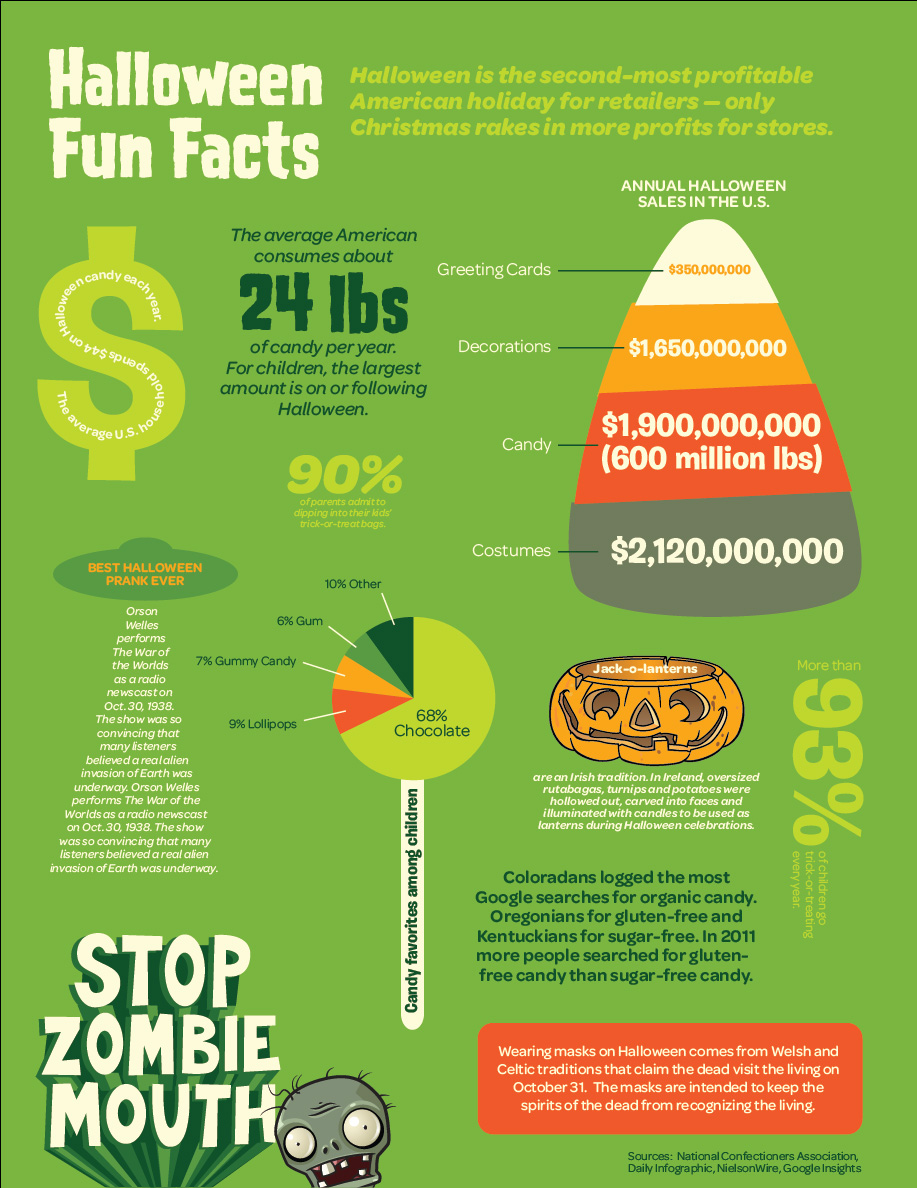
The American Dental Association and their new website,
stopzombiemouth.com (definitely worth a visit, especially if you have kids) bring us this infographic about Halloween.

Also, if you're still planning your non-candy Halloween treats, I created a Tumblr to collect ideas for healthy options: healthyhalloween.tumblr.com

Wednesday, October 24, 2012

The Food Desert Project: Thomas Jefferson's Perloo

011
Pilau, or Perloo (for those of you who love Pogo like we do,) is an American Lowcountry rice dish based loosely on the rice pilafs and biryanis of the middle east and India.  I don't know if you are aware of the adventurous kitchen of founding father Thomas Jefferson, but he was about as experimental a gourmet as was possible before air travel.  This simple dish is purported to be one of his favorites, mostly because the original used both pignoli and pistachios, exotic nuts just being introduced into Europe via Italy.  The Glory of Southern Cooking reports that Jefferson most likely brought back both kinds of trees to cultivate at Monticello, and he might well be responsible for bringing in the cultivars we use in the US today. (Jefferson's garden had an unbelievable impact on American horticulture and agriculture.)

This is one of those simple dishes that packs a lot of flavor into a small, plain package:  I can't wait to see how it goes with the turkey I'm planning to roast tonight!  If your food desert doesn't offer unsalted raw nuts, give them a quick soak in warm water and then rinse and drain them before toasting; you may want to eliminate the salt entirely.  You may not be able to find pignoli and they are expensive no matter where you find them, so I substituted pepitas, or roasted pumpkin seeds.  If you can't find those, use sunflower seeds.

0012 cups low-sodium chicken stock
2 tbsp butter
1 cup long-grain or converted rice
1/2 cup pistachios
1/4 cup pepitas or pignoli
1 tsp salt (or salt to taste if using rinsed salted nuts)
1/4 tsp nutmeg


Put the butter, stock and rice in a pot and bring to a boil.  Cover and turn the heat to low for about 20-25 minutes, or until all the liquid is absorbed.  In the meantime, toast the nuts lightly in a skillet until they are fragrant.  When the rice is done, mix in the nutmeg and nuts and season with salt.  Enjoy!

004

I can't think of Perloo without thinking of Walt Kelly's Pogo cartoons of the 1960s.  We are blessed to have inherited a neighbor's collection of Pogo comic books, and in one, Equal Time for Pogo, there is an entire strip dedicated to the 1968 Republican candidates for President...including George W. Romney and Ronald Reagan.  I remember first coming across this strip during the Reagan era, and now, here it is again...the timelessness of these pieces is amazing!

Just a little reminder for all our US readers: history is watching us!  Get out there and exercise your right to cast an educated vote for the candidates and issues of your choosing!  (P.S.  For extra bonus points, I heard a rumor that early voters are removed from political phone-call lists!  Yippee!)